

Workplace conflict often gets a bad reputation—it’s seen as a disruption, a roadblock to productivity, or a sign of dysfunction. But what if, instead of avoiding it, organizations embraced conflict as a catalyst for growth? When approached with the right mindset, disagreements can fuel better teamwork, spark innovation, and drive long-term success.
Conflict isn’t just about clashing personalities; it’s an inevitable part of workplace dynamics. As Robbins and Judge (2019) explain, conflict arises when individuals perceive a threat to their goals or values. It can start small—like a disagreement over workload—and, if left unresolved, escalate into a major obstacle. However, when managed effectively, conflict can serve as a powerful tool for refining ideas, strengthening collaboration, and pushing organizations forward.
Take a tech startup, for example. Engineers may prioritize quality and long-term stability, while sales teams push for rapid product launches. At first glance, these competing priorities seem like a recipe for tension. But with the right conflict management strategies, this tension can lead to balanced decision-making, stronger cross-functional collaboration, and ultimately, better products.
When we hear the word “conflict,” our minds often jump to thoughts of tension, frustration, and discord. It’s a word loaded with negative emotions, conjuring up images of heated arguments, broken relationships, or unresolved struggles. Conflict, it seems, is inherently bad. But is it really?
In reality, not all conflict is harmful. Conflict can actually be a powerful catalyst for growth. While it can lead to misunderstandings or heightened emotions, it can also challenge us to think differently, explore new ideas, and strengthen our relationships. When approached with an open mind and a willingness to engage, conflict can lead to deeper understanding, more innovative solutions, and stronger bonds.
The difference between negative and positive conflict lies in how we respond to it. Negative conflict often arises when we approach disagreements defensively—focusing on winning the argument rather than understanding the other perspective. This kind of conflict can breed resentment, stress, and emotional exhaustion. Without resolution, it has the potential to erode trust and cause long-term damage to relationships.
On the flip side, positive conflict occurs when we engage with the disagreement constructively. Instead of shutting down or ignoring the issue, we take the time to listen, seek common ground, and collaborate. In these situations, conflict can become a tool for innovation, pushing us to think outside the box, challenge assumptions, and grow both personally and professionally.
Ultimately, conflict is not inherently negative or positive—it’s how we handle it that matters. By embracing conflict as an opportunity for growth and resolution, we can use it to our advantage, leading to richer, more fulfilling outcomes. So, the next time you find yourself in conflict, remember that how you approach it can determine whether it becomes a stumbling block or a stepping stone.
- Functional Conflict fuels creativity, innovation, and problem-solving. When teams challenge each other’s ideas in a constructive way, they often develop better solutions. A product design team, for instance, might debate over the best user experience, leading to an innovative breakthrough.
- Dysfunctional Conflict, on the other hand, disrupts productivity, lowers morale, and creates a toxic work environment. A long-standing feud between two department heads can halt progress and make the workplace unbearable for their teams.
Why Conflict Arises
To resolve conflict effectively, we need to dig deeper into its root causes.
- Unclear Roles & Expectations – When employees don’t know who’s responsible for what, misunderstandings occur.
- Poor Communication – Lack of transparency breeds mistrust.
- Competing Priorities – Different departments may have conflicting objectives.
- Unfair Policies – Inconsistent rewards or unclear promotion paths lead to resentment.
For instance, in a logistics firm, individual incentives created competition between teams instead of collaboration. By shifting to team-based rewards, conflicts reduced, and cooperation improved.
Conflict Follows a Predictable Pattern:
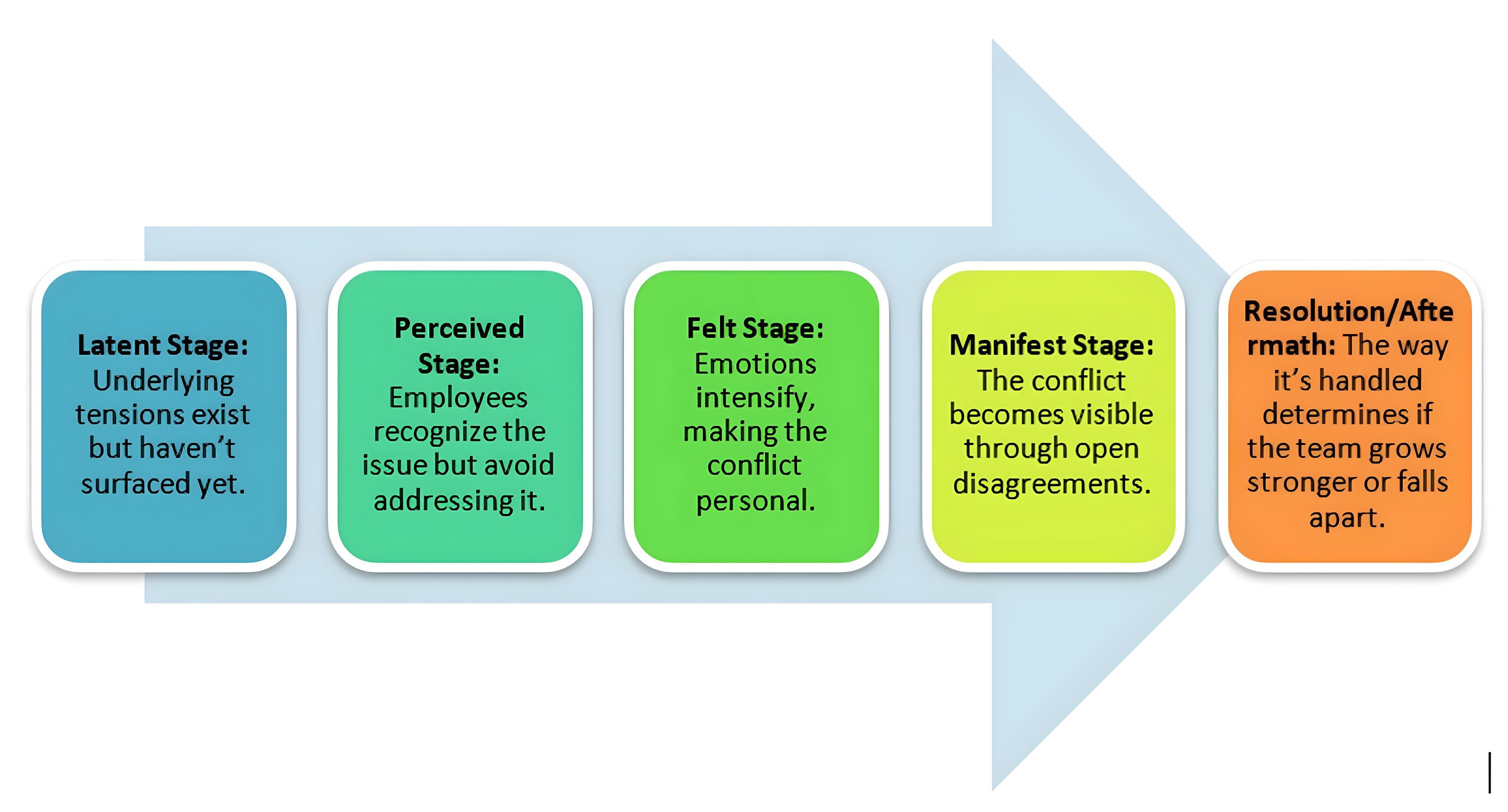
- Latent Stage: Underlying tensions exist but haven’t surfaced yet.
- Perceived Stage: Employees recognize the issue but avoid addressing it.
- Felt Stage: Emotions intensify, making the conflict personal.
- Manifest Stage: The conflict becomes visible through open disagreements.
- Resolution/Aftermath: The way it’s handled determines if the team grows stronger or falls apart.
So how can businesses shift their approach and turn conflict into a competitive advantage?
Strategies to Turn Conflict into Growth
1. Investigate Before Reacting – Jumping to conclusions can worsen conflict. Leaders should gather facts, listen to both sides, and understand different perspectives.
2. Find Common Ground – Teams often have shared goals. Highlighting these can shift focus from competition to collaboration.
3. Brainstorm Win-Win Solutions – Encouraging all parties to contribute ideas leads to fair resolutions.
4. Establish Clear Agreements – Once a solution is found, everyone should be accountable for implementing it.
5. Follow Up and Adjust – Conflict resolution isn’t a one-time fix. Regular check-ins ensure the changes are working.
One of the most powerful tools in conflict resolution is Emotional Intelligence (EI). Leaders with high EI can:
- Read between the lines and identify the root of tensions.
- Keep emotions in check during difficult conversations.
- Empathize with different perspectives to find balanced solutions.
For example, at a tech company, a manager known for his EI skills turned a major disagreement into a team-building moment. By acknowledging both sides’ frustrations and guiding the conversation toward a shared solution, he prevented long-term resentment and strengthened the team.
At a growing startup, a lack of resources led to rising tensions. Employees felt overburdened, and meetings became confrontational. By introducing structured communication channels and workload management tools, leadership transformed frustration into collaboration.
End Notes
Workplace conflicts are inevitable, but they don’t have to be destructive. When managed well, they become opportunities for learning, teamwork, and innovation. The key lies in understanding the root causes, promoting emotional intelligence, and implementing structured resolution strategies. Conflict, when approached constructively, can lead to profound transformation. Instead of allowing differences to escalate into tension, it can become an opportunity for growth. By embracing open dialogue and seeking understanding, individuals and teams can shift from clashing to collaborating.